
3D Printing Service
We use the Fused Deposition Modeling (FDM) process, which is currently the most common type of 3D printing. We can accept OBJ and STL file types for 3D printing. Most modelling software has the ability to export in one of these formats.
If you need advice with this, please get in touch.
Pricing
Our 3D prints are priced on machine time plus material, so you only pay for what your model actually uses. Material is charged by type — standard, engineering, or multi-material — because the filaments differ a lot in cost. A minimum order charge of £20 covers setup and file prep. Tell us your budget and turnaround and we’ll help shape the print to suit..
How long will my print take?
The size of your model, infill density and layer height all affect print time. Taller layer heights print faster but leave visible ridges that may need sanding; finer layers look better but take longer. Denser infill is stronger but slower. Send us your files and we’ll give you an estimated time and price — most jobs land between 8 and 24 hours of machine time.
PLA/PETG
Everyday prototyping and props. Great surface finish, wide colour range, cost effective for most jobs
Engineering Filaments
For props that need heat resistance, strength or durability we can print in ABS, Nylon, ASA and carbon fiber reinforced filaments.
Post Processing
We can prime and sand any print to a desired surface finish, charged at £15/hr.
3D Printing Design Considerations
If you’re already creating computer models for visual representation, you’re not far from being 3D print ready. It’s likely that the software you are using can export for 3D printing, with a few tweaks. We are happy to advise you on any questions you have.
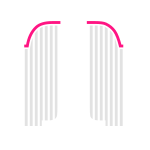
Orientation
If your model has overhangs (surfaces of the model with nothing between it and the floor) it will need support material. Support material is a temporary structure, like scaffolding, that can be removed once the print is finished. The support structure will always leave a mark on the surface it was attached to, but this can be sanded smooth.
Size
Our printer has a build volume of roughly 330 × 320 × 325mm. Most props fit comfortably; larger pieces can be split into parts that key together with dovetails or bond with two-part epoxy. Tall models may need reorienting or splitting — send the file and we’ll advise.
Are You Ready To Print Your Design?
Pros and Cons of 3D Printing
Pros
- Achieves complex geometry that’s hard to make any other way
- Huge library of free models online
- Little file prep if you already model in 3D
- Multi-material printing means colour and flexible parts without painting or assembly
- Enclosed, heated chamber handles engineering and high-temp materials
Cons
- Post-processing usually required to get a prop screen-ready
- Melting temperature of PLA is relatively low. Consider if the prop will be in a hot environment and choose the right material for your application.
- Long print times are not economical for large quantities. Consider moulding and casting from a print instead – we can help you with this
3D Printed Models
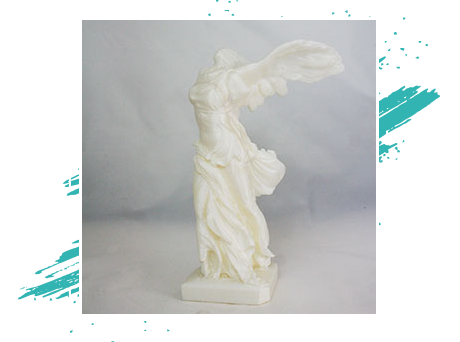
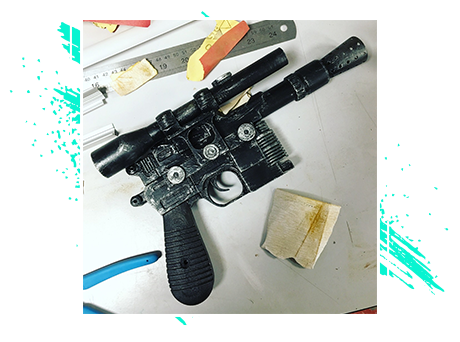
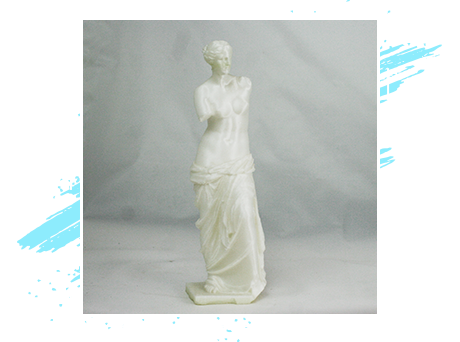
Many free and open sourced models can be found online from sites like Thingiverse or MyMiniFactory. Some museums even upload scans of their statues! Always be sure to check the licensing before committing a model to a project.
These examples were found online and printed at KitBash.
Materials
We stock a core range of PLA and PETG and order in engineering and specialist filaments to suit your project, so give us as much notice as you can for anything out of the ordinary. Not sure which material suits your prop? Ask us — matching the material to the job is half the work.